06/03/2026 | SIAN
Transforming obsolete hospitality assets into unique and memorable developments
The hospitality sector is undergoing a structural shift. High construction costs, financial pressure, and stricter ESG criteria have altered the traditional development logic. Building from the ground up in prime locations implies higher CAPEX, longer timelines, and significant exposure to budget deviations.
Although many of the best locations have already been occupied, there are still true hidden gems in emerging destinations with strong growth potential. Whether beachfront, within natural reserves, or near established tourism hubs, the challenge is not the location itself but the product: hotels built 15 or 25 years ago, with rigid structures, high-energy consumption, and offerings that now feel undifferentiated for a more conscious, experience-driven, and demanding traveler.
According to industry analyses, repositioning and renovation have become the preferred path for value creation among hotel investors. The opportunity no longer lies in indiscriminately expanding inventory, but in reimagining existing assets through a more efficient, market-aligned logic.
ESG and efficiency: financial, not reputational, variables
Sustainability is no longer a marketing argument; it is now an investment criterion. Funds, banks, and family offices evaluate energy efficiency, climate resilience, and operational performance before committing capital.
An asset with high-energy consumption, inefficient materials, and elevated maintenance costs not only faces greater OPEX, but also diminishes its appeal for financing and future exit. Additionally, the construction industry accounts for nearly 40% of global carbon emissions, increasing regulatory scrutiny over new traditional developments.
Strategic renovation allows this gap to be closed without assuming the full risk of a greenfield project. Incorporating efficient energy systems, lower-impact construction solutions, and smart technology improves operating margins and strengthens the asset’s ESG profile.
The new traveler redefines the concept of luxury
Contemporary luxury no longer revolves solely around opulence or scale. Recent studies cited by
HospitalityNet show that the new generation of travelers prioritizes experiences that spark curiosity (77%), generate joy (65%), and inspire awe in nature (57%).
This reshapes the repositioning strategy. Updating finishes is no longer enough. The asset must offer connection to the environment, authentic design, structural wellbeing, and differentiated experiences within the same property.
The owner’s challenge is clear: how to transform the product without shutting down operations for months or compromising cash flow.
Modularity applied to rehabilitation: intervene without stopping the business
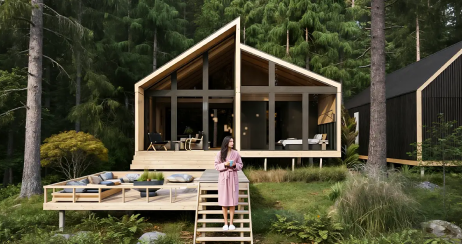
This is where sustainable modular architecture gains strategic relevance. Instead of demolishing or undertaking prolonged invasive construction, integrating modules allows intervention in phases.
This enables a progressive model:
Add new premium typologies without altering existing infrastructure.
Create boutique micro-clusters within the same property.
Integrate wellness spaces and contemporary gastronomic experiences.
Test demand before scaling.
Phased intervention reduces operational impact and allows revenue to continue while improvements are executed. Manufacturing in a controlled environment brings predictability in costs and timelines, reducing uncertainty compared to traditional construction.
More than a simple expansion, it becomes an orderly transition strategy.
Revalue without losing location
Many resorts in beaches, mountains, or natural reserves hold a value that would be difficult to replicate today due to environmental restrictions and limited land availability. Demolishing to rebuild erases that history. Maintaining without evolving weakens it.
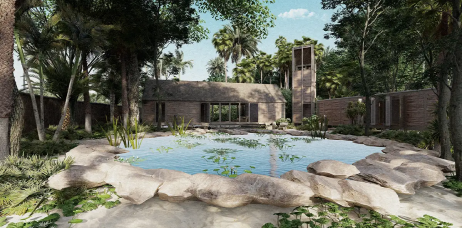
Modular architecture enables a different approach: integrating what exists into a renewed vision. It is not only about adding contemporary units, but about reinterpreting structures that are already part of the place.
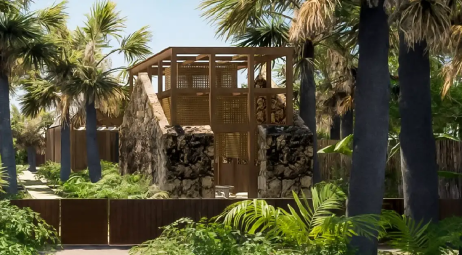
An abandoned cabin, a secondary volume, or an unused space can become a central element of the new concept. Through tailored design, compatible materials, and precise construction systems, the old integrates with the new without losing coherence.
At SIAN Studio, we approach these interventions as an exercise in architectural continuity: preserving identity, upgrading performance, and projecting new functional meaning. The result is not rupture, but evolution of the asset.
From tactical renovation to strategic repositioning with SIAN
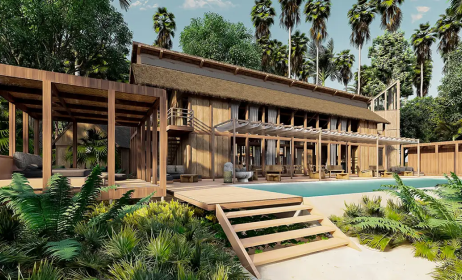
At SIAN, we approach refurbishment as a comprehensive repositioning strategy. We design high-precision sustainable modules that integrate into existing assets with minimal operational disruption.
Our approach combines industrialized manufacturing, premium architecture, and energy efficiency, enabling owners and funds to transform obsolete hotels into developments aligned with contemporary luxury: genuine sustainability, differentiated experience, and long-term resilience.
Modularity is not just a construction solution. It is a strategic tool to reduce risk, scale in phases, and structure assets prepared for the next 20 years.
Structuring the transition with financial vision
A well-located asset does not need to start from zero. It needs a strategy.
If you are an owner, operator, or investment fund manager evaluating how to reposition your hotel or resort without assuming the risk of a prolonged traditional construction timeline, we can analyze together how to structure a progressive transition that combines efficiency, differentiation, and financial control.
To reimagine is not to demolish; it is to design the next chapter with precision.
Comments