20/02/2026 | SIAN
Net-zero spaces:
what the standard really implies
A net-zero space is a building designed so that the total amount of carbon emissions associated with its construction and operation equals zero or is fully offset. This involves measuring, reducing, and balancing both the emissions embedded in materials and those derived from energy consumption throughout its lifecycle.
The concept is based on a technical premise: every building generates emissions. Neutrality does not mean the absence of impact, but rather control, systematic reduction, and verifiable compensation.
Two carbon dimensions: embodied and operational
To understand what a net-zero modular space is, it is necessary to differentiate between two types of emissions.
• Embodied carbon
This refers to emissions generated during raw material extraction, material manufacturing, transportation, and the construction process. The construction industry is responsible for approximately 40% of global emissions, and a significant portion originates in this initial phase.
• Operational carbon
This refers to emissions associated with the building’s energy consumption during use: climate control, lighting, hot water, equipment, and other systems.
A carbon-neutral habitable space addresses both dimensions. Installing solar panels is not sufficient if the materials used generated an excessive footprint during their production.
Reduction of embodied carbon
Reducing embodied carbon begins with material selection and construction process efficiency. This stage determines a significant portion of the asset’s total footprint, even before it becomes operational.
The use of certified timber structures can help reduce emissions compared to concrete- or steel-intensive systems, due to wood’s capacity to store carbon throughout its lifecycle. The choice of structural material is not only an aesthetic or economic decision; it is a strategic one that directly affects the project’s emissions balance and ESG profile.
At SIAN, we work with high-durability timber structures with a projected lifespan of up to 100 years, and materials certified under demanding standards. This allows us to integrate sustainability and structural resistance within the same construction system, reducing the need for premature replacements and protecting the asset’s value.
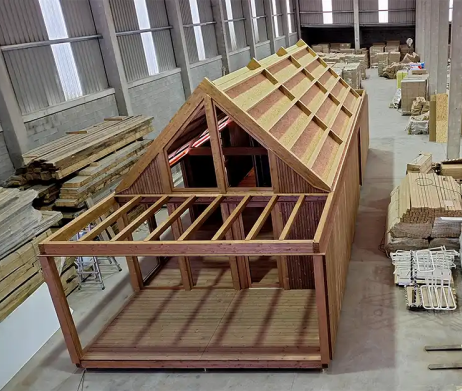
In addition, we industrialize the process through precision manufacturing using CNC technology. Each component is produced in a controlled environment, optimizing cuts, reducing waste, and improving resource efficiency. This precision reduces on-site errors and prevents rework that increases material and energy consumption.
When pursuing the net-zero standard, this stage requires quantifying embodied emissions and applying reduction strategies before considering any external offset mechanism. In our case, measurement and control begin in the factory, where technical variables can be managed with greater precision and traceability.
Energy efficiency and reduction of operational carbon
The second dimension of the net-zero standard focuses on the asset’s energy performance throughout its lifecycle. Here, we evaluate how the modular space behaves in daily operation and the volume of emissions generated from its energy consumption.
A carbon-neutral space must minimize energy demand from the design stage. This involves defining orientation, thermal envelope, insulation, solar control, natural ventilation, and adequate airtightness levels. These decisions reduce the need for artificial climate control and lower baseline energy consumption before incorporating any additional technological systems.
At SIAN,
we integrate these criteria during the module’s engineering stage. We design the envelope with efficiency standards that optimize thermal performance across different climates and reduce HVAC system loads through properly dimensioned passive solutions. Efficiency is not added at the end; it is embedded within the construction system.
Once demand is optimized, the required energy must come from renewable sources. We incorporate scalable energy configurations that can cover between 20% and 100% of total consumption, depending on the type of development and its location. In certain contexts, modules can operate partially or fully off-grid, reducing dependence on conventional networks and strengthening operational resilience.
The technical objective of the net-zero standard is for the renewable energy generated annually to be equivalent to or greater than the asset’s total annual consumption. Achieving this requires energy simulations, accurate solar system sizing, and monitoring of real operational performance.

The reduction of operational carbon does not depend solely on installed technology, but on the coherence between architectural design, system efficiency, and the operational model.
Lifecycle, resilience, and continuous measurement
The net-zero standard is not limited to the design stage or the installation of energy systems. It requires evaluating the asset’s performance throughout its entire lifecycle.
This includes analyzing structural durability, maintenance requirements, adaptability potential, and end-of-life management. A building with an extended lifespan reduces the need for replacements, intensive renovations, or premature demolition, all of which are associated with additional emissions. For this reason, structural resistance and material quality form part of the neutrality calculation.
In our case, we design modules capable of withstanding demanding conditions such as humidity, salinity, or extreme weather events, which reduces corrective interventions and prolongs the project’s financial stability.
Controlled and short-duration installation also influences total impact. Systems that can be assembled within 5 to 8 days reduce on-site machinery, energy consumption related to construction, and prolonged environmental disruption, while allowing earlier entry into operation.
Another relevant aspect is adaptability. The possibility of disassembly, relocation, or future expansion reduces the risk of structural obsolescence. An asset that can evolve according to new needs avoids demolition and reconstruction processes, which typically involve high additional emissions.
To evaluate all of the above, Life Cycle Assessment (LCA) becomes a fundamental tool. Measuring embodied, operational, and projected emissions allows for data-based decision-making and strengthens ESG reporting.
Offsetting and final balance
If, after applying all possible reduction strategies, residual emissions remain, these can be offset through certified carbon capture or reduction projects. However, offsetting is the final resource within the technical hierarchy.
The priority is always to reduce first, generate clean energy second, and offset only what is unavoidable.
Technical and regulatory implications
The net-zero standard has increasing implications in regulations, ESG certifications, and investment criteria. More than 60% of travelers report prioritizing sustainable accommodations, which also influences hospitality and micro-resort developments.
From a technical perspective, achieving neutrality requires rigorous measurement, energy simulations, strategic material selection, and continuous operational monitoring.
A technical approach that requires planning from the origin
The net-zero standard is not achieved through isolated interventions. It requires planning from the conceptual phase, rigorous energy simulations, strategic material selection, and monitoring of real operational performance.
If you are evaluating a modular project under carbon neutrality criteria, the right moment to define its feasibility is before initiating final architectural design.
We can review technical variables, climate conditions, estimated energy demand, and modular configuration options to determine whether the net-zero objective is achievable within your specific context.
Carbon neutrality is not declared; it is calculated and built from the outset.
Comments