14/08/2025 | SIAN
Energy-efficient cabins by SIAN: Designed to save energy, money, and emissions
Can you imagine a cabin that regulates its temperature, recycles water, and barely needs air conditioning? This isn’t science fiction: it’s an energy-efficient home. More and more people are choosing them, not just for environmental reasons, but also for savings, comfort, and autonomy.
In a world where energy efficiency is no longer optional but essential, rethinking how we inhabit space is key. The residential sector accounts for around 20% of global energy consumption, according to the International Energy Agency (IEA). And in extreme climates, such as tropical coastal zones or areas with strong seasonal shifts, up to 60% of household energy use goes toward heating or cooling.
In this context, energy-efficient modular construction offers a real, scalable solution. But not just any prefab: we’re talking about spaces designed from the ground up to adapt to their environment, reduce consumption, and, whenever possible, generate their energy.
What makes a cabin truly energy-efficient?
It’s not just about solar panels (though they help). A truly efficient home consumes less energy from the start, thanks to:
• Smart orientation: In the southern hemisphere, for example, north-facing windows capture more natural light without overheating.
• Thermal insulation: Materials like fiberglass, cork, or sheep’s wool prevent heat loss or gain. (A well-insulated structure can reduce your energy bills by up to 30%.)
• Natural ventilation: High ceilings and strategic windows = airflow without fans.
• Clean tech: Solar panels, geothermal systems, and rainwater reuse all play a role.
Climate-first design
Every site has its unique sun, wind, and temperature conditions. That’s why bioclimatic analysis is always our first step. Solar exposure, building orientation, cross-ventilation, shading strategies, and high-performance materials are considered from the earliest design stages.
Designing with the environment, not against it, can cut energy use by up to 30% in warm or temperate climates and reduce the need for mechanical systems.
Construction that insulates, breathes, and protects
In traditional construction, energy loss often comes from blind spots: poorly insulated roofs, thermal bridges in the walls, or windows without solar control. In a modular energy-efficient cabin, these issues are addressed in the factory.
At SIAN, we use high-efficiency structural panels, continuous insulation, triple-glazed windows filled with argon gas, and passive ventilation systems that maintain comfortable temperatures year-round, reducing the need for air conditioning or heating. According to the Passive House Institute, these systems can reduce energy demand by up to 80% compared to conventional buildings.
And what about the cost of an energy-efficient cabin?
An energy-efficient cabin may require between 5% and 15% more in initial investment, but that difference pays for itself. In less than 7 years, savings on electricity, gas, and water offset the investment, and from there on, it’s all profit.
And the benefits aren’t just long-term:
• In Canada, the Canada Greener Homes Grant offers up to CAD 5,000 in grants and up to CAD 40,000 in interest-free loans for energy upgrades and renewable systems.
• In the United States, the Federal Solar Investment Tax Credit (ITC) allows you to deduct 30% of the cost of a solar system, and in California, programs such as DAC-SASH cover up to 100% of solar installation costs for qualifying households.
• The new 2025 California Energy Efficiency Code incentivizes efficient technologies such as heat pumps, electric-ready buildings, and solar with integrated storage, projecting savings of up to $4.8 billion and a reduction of 4 million tons of CO2.
• In markets like Canada and the U.S., properties with energy efficiency certifications (ENERGY STAR, LEED) can sell for 8% to 10% more, according to the U.S. Department of Energy and Natural Resources Canada.
As an international reference, in Spain, homes with an “A” energy rating consume up to 70% less energy than those with a “G” rating.More than an extra expense, energy efficiency is a strategy for saving, comfort, and added value.
Designed to produce, not just consume
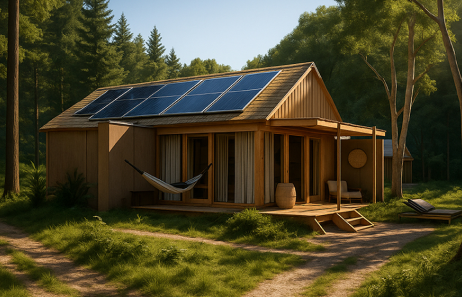
Efficiency isn’t the only goal. We also aim for every cabin to generate at least part, or even all, of the energy it consumes. With properly sized solar panels, storage batteries, and smart consumption technologies, we can create hybrid or even fully off-grid models, depending on the location and lifestyle.
In some of our remote-area projects, the cabins operate entirely without a connection to the grid, maximizing solar radiation and using efficient backup systems. What’s more, over its lifetime, a SIAN cabin can reduce annual CO2 emissions by at least 2.1 tons compared to a standard building of the same size and functionality.
Living (and building) with intention
The future doesn’t belong to those who build more, but to those who build better.In a world where every decision matters, choosing an energy-efficient home isn’t just a responsible act — it’s a smart move that improves quality of life while reducing environmental impact from day one.
At SIAN, we design modular cabins that not only adapt to the climate, terrain, and your lifestyle, they help you live with less consumption, more comfort, and greater purpose.
Ready to live more efficiently?
Message us, and let’s design a space that saves energy and brings lasting well-being.
Comments

.png)
.png)
.png)
.png)
.png)